
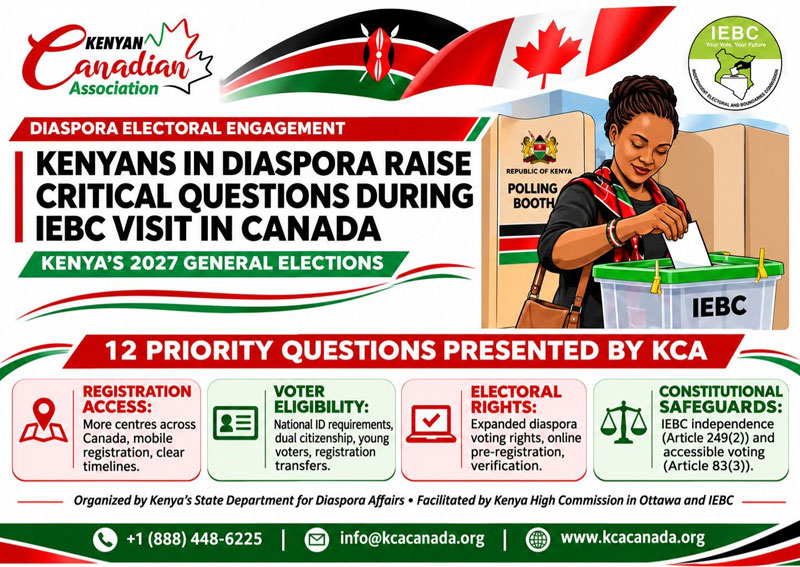
Kenyans in Diaspora Raise Critical Questions During IEBC Visit Canada
November 14, 2026 | Toronto, Canada
Diaspora Community Leaders Call for Expanded Voter Registration, Constitutional Safeguards, Local Electoral Staffing, Greater Accessibility and Electoral Technology Reforms Ahead of Kenya's 2027 General Elections
Kenyans residing across Canada participated in a virtual consultative meeting with a visiting delegation from Kenya's Independent Electoral and Boundaries Commission (IEBC), organized by Kenya's State Department for Diaspora Affairs and facilitated by Kenya High Commission in Ottawa in collaboration with IEBC, to discuss diaspora voter registration and preparations for Kenya's 2027 General Elections. The engagement brought together community leaders, professionals, academics, and representatives of diaspora organizations who raised concerns regarding electoral accessibility, constitutional rights, administrative efficiency, and the inclusion of Kenyans abroad in electoral planning.
Kenyan Canadian Association (KCA), represented by President and Executive Director Ephraim Mwaura and Vice President Abdi Mohamed, presented twelve priority questions addressing the expansion of voter registration and polling centres across Canada, mobile registration services, registration timelines, identification requirements, voting rights for dual citizens, first-time voters, transfer of existing voter registration, online pre-registration, and verification of voter information. KCA emphasized the need for IEBC to recognize Canada's vast geographical distances and establish more accessible electoral services in cities including Calgary, Edmonton, Winnipeg, Montreal, and Halifax.
Vice President Abdi Mohamed raised two additional constitutional concerns, citing Articles 249(2) and 83(3) of the Constitution of Kenya. He questioned what written safeguards would protect IEBC's independence when working with the State Department for Diaspora Affairs and diplomatic missions, particularly regarding voter registration, access to electoral data, and election staffing. He further challenged IEBC to explain how it would fulfil its constitutional obligation to facilitate voting for Kenyans whose distance from polling centres and associated travel expenses could effectively prevent them from exercising their democratic rights.
Dr. Philip Kimani Karangu, an educator, researcher, curriculum theorist, and Postdoctoral Fellow at the University of British Columbia, also made significant contributions. Dr. Karangu, who is pursuing the governorship of Nyandarua County in 2027, urged IEBC to utilize established diaspora organizations such as KCA and their existing community networks across Canada to improve voter registration, outreach, and electoral coordination. He questioned the financial justification for deploying electoral personnel from Kenya when qualified Kenyan professionals residing in Canada could potentially be recruited and trained locally at significantly lower costs, subject to IEBC's independent supervision and applicable legal requirements.
Dr. Karangu further challenged IEBC to demonstrate its commitment to being an institutional ally of the diaspora and explain what measures it had undertaken to strengthen engagement with Kenyans abroad. He also sought clarification on the status of previously submitted electoral reform proposals aimed at making elections more affordable, accessible, transparent, and verifiable, including proposals involving blockchain-based technologies and lessons from international electronic voting systems such as Brazil's.
KCA highlighted its historical contribution to diaspora voting in Canada, having previously conducted and submitted survey data in collaboration with Kenya High Commission in Ottawa that helped inform the establishment of electoral arrangements for Kenyans residing in the country. KCA has since compiled updated demographic and geographical distribution data on Kenyan communities across Canadian provinces and municipalities. According to KCA, this information is already being utilized by various levels of Canadian government for planning, community engagement, and service delivery.
Through Kenya High Commission in Ottawa, KCA is prepared to share this updated information with IEBC to support evidence-based planning for the 2027 General Elections, particularly in identifying suitable voter registration centres, organizing mobile registration exercises, and establishing accessible polling stations across Canada.
The discussions underscored the importance of reducing geographical and financial barriers, strengthening IEBC's constitutional independence, utilizing locally available professional expertise, improving electoral technology, and ensuring that diaspora concerns are incorporated into electoral planning. Participants emphasized the need for practical reforms that recognize the growing geographical distribution of Kenyan communities across Canada.
KCA called upon IEBC to provide written responses to the priority questions raised during the consultation, clarify its electoral preparations and timelines, and consider proposals submitted by diaspora stakeholders. KCA also encouraged continued collaboration among the State Department for Diaspora Affairs, IEBC, Kenya High Commission in Ottawa, and established diaspora organizations to support non-partisan voter education, community outreach, and inclusive electoral participation.
The central message from the consultation was that eligible Kenyan citizens should not be denied meaningful opportunities to vote because of where they live in Canada or their inability to afford long-distance travel to electoral centres.
The Twelve Priority Questions Presented By Kenyan Canadian Association to IEBC
The following twelve questions were presented by KCA representatives during the November 14, 2026, diaspora consultation:
- Expansion of Voter Registration and Polling Centres
What concrete plans does IEBC have to establish additional voter registration and polling centres across Canada, particularly in Calgary, Edmonton, Winnipeg, Montreal, Halifax, and other cities where Kenyan citizens face considerable travel distances?
2. Introduction of Mobile Voter Registration Services
Can IEBC introduce mobile voter registration services in collaboration with Kenya High Commission and established Kenyan diaspora organizations to reach communities across different Canadian provinces and territories, rather than requiring eligible voters to travel long distances to designated registration centres?
3. Confirmation of the 2027 Diaspora Voter Registration Timetable
What are the confirmed dates for diaspora voter registration in Canada, how long will registration remain open, and when will IEBC publish the comprehensive registration schedule, including designated locations and operating hours?
4. Use of Kenyan National Identity Cards and Passports
Will Kenyan citizens residing in Canada be permitted to register and vote using valid Kenyan national identity cards without being required to present valid Kenyan passports? What legal and administrative requirements will apply for the 2027 General Elections?
5. Expansion of Diaspora Voting Rights and Representation
What legal and institutional reforms would be necessary to expand diaspora electoral participation beyond presidential elections and referendums to include parliamentary and county elections, and what role can IEBC play in facilitating these reforms?
6. Introduction of Online Voter Pre-Registration
Can IEBC introduce secure online pre-registration to simplify the voter registration process, reduce unnecessary travel, and streamline physical registration and biometric verification requirements for eligible Kenyans residing abroad?
7. Transfer of Existing Voter Registration from Kenya to Canada
How can Kenyan citizens previously registered to vote in Kenya transfer their voter registration to Canada, and what procedures, documentation requirements, and deadlines will apply?
8. Electoral Eligibility of Kenyan Dual Citizens
Are Kenyan citizens who have acquired Canadian citizenship eligible to register and vote in Canada, and what identification and citizenship documentation must they provide to establish their eligibility?
9. Registration of Young and First-Time Diaspora Voters
What arrangements will IEBC make for Kenyan citizens turning 18 while residing in Canada, particularly those who have never previously registered to vote in Kenya?
10. Verification of Existing Diaspora Voter Registration
How can Kenyan citizens who registered during previous elections verify their voter registration status, confirm their designated polling stations, and ensure that their registration information remains accurate ahead of the 2027 General Elections?
The following two additional constitutional questions were raised by KCA Vice President Abdi Mohamed:
11. Protection of IEBC's Constitutional Independence – Article 249(2)
"Article 249(2) protects IEBC's independence. With the State Department and diplomatic missions involved in diaspora engagement, what written safeguards will ensure that voter registration, access to voter data and election staffing remain under IEBC's independent control?"
12. Constitutional Obligation to Facilitate Voting – Article 83(3)
Article 83(3) of the Constitution of Kenya states:
"Administrative arrangements for the registration of voters and the conduct of elections shall be designed to facilitate, and shall not deny, an eligible citizen the right to vote or stand for election."
"How will IEBC fulfil this obligation for Kenyans in Canada whose distance from polling centres and travel costs could effectively prevent them from voting?"
KCA has called upon IEBC to provide substantive written responses to these twelve questions, accompanied by clear implementation timelines and practical measures to improve diaspora voter registration, electoral accessibility, constitutional compliance, and participation in Kenya's 2027 General Elections.
Contact:
Kenyan Canadian Association (KCA)
Ephraim Mwaura
President and Executive Director
Abdi Mohamed
Vice President
Telephone: +1 (888) 448-6225
Email: This email address is being protected from spambots. You need JavaScript enabled to view it.
Website: www.kcacanada.org